Dominion, Unity, and the Danger of Independence
Central Thought
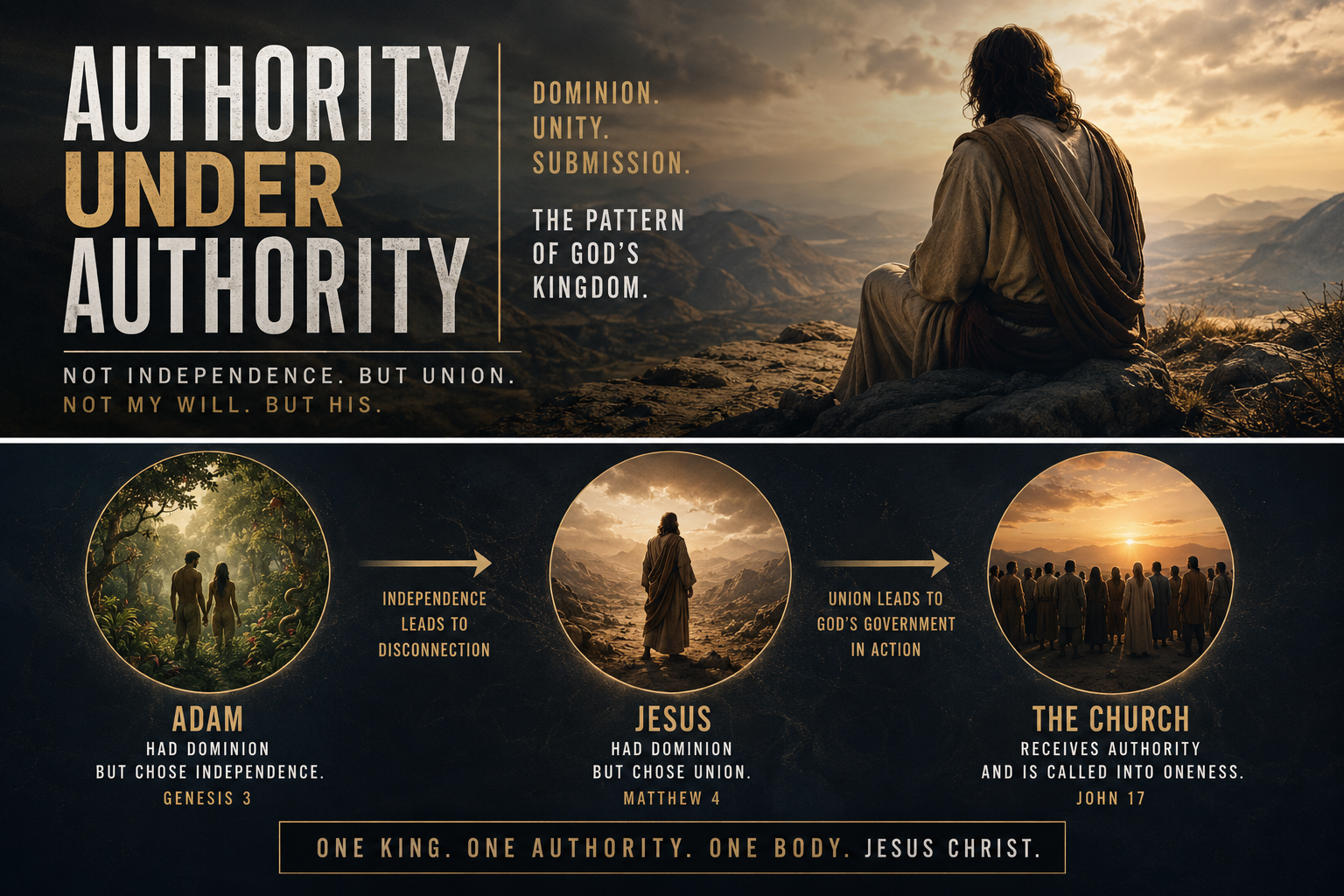
God created man for dominion, but He never created man for independence. Biblical authority is not merely the possession of power; it is the administration of God’s will by someone who remains in union with God, submitted to His government and properly related to His Body. This gives us a simple progression: Adam had dominion but chose independence, Christ had dominion but remained in union, and the Church receives authority and is called into oneness. So the first question is not simply, “Do I have authority?” The deeper question is, “From what relationship and under whose government am I exercising it?”
1. Man Was Created for Dominion
Genesis 1:26 states, “Let us make man in our image, after our likeness: and let them have dominion…” Dominion was part of God’s original intention for man, who was created to govern the earth under God. But notice the specific order: God → Man → Creation. Man stood over creation, but he remained under God. He was never intended to become an independent authority; his dominion was strictly delegated dominion. God spoke, man received God’s word, and man administered God’s government upon the earth.
Therefore, man’s authority depended entirely upon his continuing relationship with the One from whom that authority came. The key principle is that man was given dominion, but never independence. This distinction is vital, because dominion says, “God has entrusted something to me,” while independence says, “Because it has been entrusted to me, I may now govern it however I choose.” That was never God’s intention.
2. Adam: Dominion Corrupted by Independence
This framework helps us understand the true nature of the temptation in Eden. The serpent did not merely tempt Adam and Eve to eat fruit; he introduced the possibility of life independent of God’s word. As Genesis 3:5 records, “Ye shall be as gods, knowing good and evil.” Until this point, God determined what was good and what was evil. God had spoken, and man’s sole responsibility was to live within what God had spoken. But the serpent presented another possibility: you can know for yourself, you can determine for yourself, and you can act for yourself. This is the seed of independence.
Adam was already created in God’s image and already possessed dominion, yet the temptation suggested that something more could be gained by stepping outside the boundary of God’s word. The tragedy is that man attempted to become more by separating himself from the very One from whom his authority came. So the key principle is that the fall was not merely the breaking of a rule; it was man’s movement away from dependence upon God toward self-government. Man wanted dominion without submission, authority without dependence, knowledge without receiving, and government without remaining under God’s government. Once man stepped outside God’s order, the dominion he had been given became corrupted.
3. Jesus Faces the Same Question Differently
Now come to the wilderness in Matthew 4:3, where Satan challenges Him: “If thou be the Son of God, command that these stones be made bread.” Notice the language: “If thou be the Son of God…” followed by, “command…” Satan deliberately points Jesus toward His identity, His ability, and His authority. Jesus certainly possessed authority, so the question was not whether Jesus could turn stones into bread. Rather, the deeper temptation was: Will You exercise what belongs to You as Son independently of the Father? In other words: You are the Son of God. You have authority. You are hungry. Why wait? Command.
This is where Jesus succeeds where Adam failed. Jesus answers in Matthew 4:4, “Man shall not live by bread alone, but by every word that proceedeth out of the mouth of God.” Adam stepped outside the word God had spoken; Jesus refused to move without the word currently proceeding from God. Adam chose self-determination; Jesus chose dependence. Adam had dominion but moved toward independence; Jesus had immeasurably greater authority but remained in perfect union with the Father. The key thought is that the temptation was not merely to use power wrongly, but to use legitimate power independently. That makes the temptation much more subtle. Something does not have to be evil in itself for its exercise to be outside God’s government. Jesus needed food, Jesus possessed power, and turning stones into bread was within His ability. Yet, ability is not permission.
4. Jesus Reveals the True Pattern of Authority
Jesus later explains the principle governing His entire ministry. In John 5:19, He states, “The Son can do nothing of himself, but what he seeth the Father do…” And again in John 5:30, “I can of mine own self do nothing…” This sounds strange coming from someone with such extraordinary authority. Jesus commanded demons, sickness, storms, the dead, and creation itself. Yet the One who could command so much says, “I can of mine own self do nothing.”
This was not weakness; this was perfect government. Jesus’ authority did not operate as independent self-expression; His authority expressed His perfect union with the Father. The Father willed, the Son acted, and heaven’s government became visible upon the earth. So the key principle is that Jesus did not demonstrate authority by independence from the Father. He demonstrated authority through perfect alignment with the Father. This means submission does not diminish authority; submission gives authority its proper order.
5. The Unity of the Godhead Shows Us the Pattern
Jesus says in John 10:30, “I and my Father are one.” There is distinction, yet there is unity. The Father is not the Son, and the Son is not the Father, yet there is no individualistic independence within the Godhead. Jesus does not present Himself as an autonomous center competing with the Father; His Sonship is always expressed within relationship.
This becomes even more remarkable in John 17:21, where Jesus prays, “That they all may be one; as thou, Father, art in me, and I in thee… That they also may be one in us…” Jesus takes the unity between Himself and the Father and presents it as the pattern for His people. God’s intention is therefore not merely to produce powerful individuals; He is forming a people who are one with Him and one with one another. This has enormous implications for authority because authority leans toward unity, not individualism.
- Individualism says, “I have authority,” while Kingdom says, “We are under His authority.”
- Individualism asks, “What can I do?” while Union asks, “What is the Father doing?”
- Individualism says, “I have the gift,” while Union asks, “How does this gift serve God’s purpose and His Body?”
- Individualism celebrates independence, while Kingdom authority celebrates alignment.
6. The Centurion Understood Authority Because He Was Under Authority
This principle appears beautifully in the story of the Roman centurion. In Matthew 8:8–9, he tells Jesus, “I am a man under authority, having soldiers under me…” Notice his precise understanding: he does not merely say, “I am a man with authority.” He begins by stating, “I am a man under authority.” Then he explains that because of this divine order, he can say to one, “Go,” and he goes, and to another, “Come,” and he comes.
The centurion understood something profound: authority flows strictly through order. His ability to command those beneath him existed solely because he himself was submitted to a larger structure. This is why spiritual authority and independence are entirely incompatible. The person who wants everyone beneath them but recognizes nobody above them completely misunderstands how authority works. The key principle is clear: before authority asks who is under you, authority asks who you are under.
7. Dominion Is God’s Government Passing Through Man
Consider the language of the prophet in Jeremiah 22:29: “O earth, earth, earth, hear the word of the LORD.” Here, a man speaks directly to the earth, and that is a vivid display of dominion. But notice what he commands the earth to hear. He does not say, “Hear my opinion,” “Hear my ambition,” or even merely, “Hear my command.” He says, “Hear the word of the LORD.”
This is perhaps one of the clearest biblical pictures of true dominion. God speaks, man hears, man agrees, and then man speaks. Creation responds to God’s government administered through man. Therefore, while the authority is entirely real, its source remains fundamentally in God. The pattern is always: God speaks → Man receives → Man agrees → Man administers → Creation responds. This is the essence of authority under authority.
8. The Church Is a Body, Not a Collection of Independent Kings
Jesus’ prayer in John 17 leads naturally into the framework of the Church. If true authority flows from union, then the Body of Christ cannot function properly through isolated spiritual individualism. Paul writes in 1 Corinthians 12:21, “And the eye cannot say unto the hand, I have no need of thee…” The eye may be powerful, the hand may be highly gifted, and the foot may perform its function exceptionally well, but none can become the Body by itself.
Every member possesses something valuable, but every member also desperately needs something from another. This interdependency is God’s divine protection against individualism. The more we understand the Kingdom, the less impressed we should become with the idea of the independent, powerful man. God’s pattern is a single Body with many members, different functions, and one Head, who is Christ. So spiritual maturity should move us away from the mindset of “me, my gift, my calling, my authority, and my ministry,” and toward “Christ, His purpose, His people, His Body, and His government.”
9. What This Means for Us
Jesus has genuinely given His people authority, as recorded in Luke 10:19: “Behold, I give unto you power… over all the power of the enemy…” We should never deny or shrink back from the authority Christ has given us, but we must deeply understand its true nature. We are not independent spiritual authorities; we are representatives of another King.
Therefore, before asking, “Can I command this?”, we should also ask, “What is God saying?” Before asking, “Do I have authority here?”, we should ask, “Am I aligned with the One whose authority I carry?” And before asking, “What can my gift accomplish?”, we should ask, “How does my gift serve Christ and His Body?” Prayer, therefore, is not merely a place where we gather power so that we can go and exercise it on our own. Prayer is where our will becomes aligned with God’s will. We must hear before we speak, receive before we administer, and come under authority before we ever attempt to exercise it.
10. The Mark of Mature Authority
Jesus' temptation gives us an extraordinary picture of true maturity. Jesus had the absolute ability to act, the authority to act, and a legitimate personal need for food. Yet, He resolutely refused to act independently. This demonstrates that one of the greatest proofs of authority is actually restraint.
Maturity is not simply knowing, “I can command.” Maturity also knows, “I do not need to command unless the Father wills it.” The immature person sees power and asks, “What can I do with this?” The mature person sees power and asks, “What does God want to do with this?” That is the heart of authority under authority.
Closing Reflection
The biblical narrative begins with man being given dominion, but that dominion was never meant to produce independence. Adam had dominion and chose independence; Jesus had dominion and chose union. Now, the Church has been given authority and is called into oneness.
The Kingdom of God is therefore not a collection of independent kings each exercising personal power. There is only one King, one Head, and one Body, made up of many members through whom His government is expressed. Therefore, the deepest lesson of spiritual authority is not simply learning how to command, but learning how to remain one with the One whose authority we carry.
Dominion is not doing whatever I have the power to do; dominion is administering the will of the One under whose authority I stand. The pattern of mature authority always remains:
- Union before expression.
- Hearing before speaking.
- Submission before command.
- The Body before individualism.
- God’s will before my ability.
True authority does not lead us away from dependence upon God. In fact, the greater the authority, the deeper the necessity for absolute union
Comments